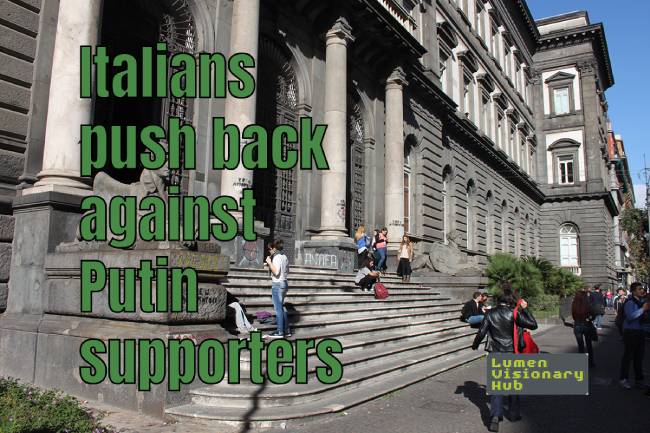
On the eve of Christmas, a group of pro-Russian figures in Naples, Italy, decided to hold a conference on the topic: “Russophilia, Russophobia, Truth.” The event took place at the University of Naples Federico II. It was organized by the local branch of the National Association of Italian Partisans (ANPI).
The conference was attended by Putin supporters such as Angelo d’Orsi, a university professor, and Alessandro Di Battista, a former member of parliament from the Five Star Movement. These figures are known for their criticism of NATO’s eastward expansion policy and their assertion that Russia did not invade Ukraine, but that Ukraine is in the midst of a civil war.
During the conference, a verbal discussion broke out between the speakers and the audience, which escalated into a scuffle. In particular, university students asked the speakers critical questions about the war in Ukraine and their relations with Moscow.
Professor d’Orsi refused to answer the students’ questions: “What were you doing in Russia, on Putin’s Russia Today TV channel?” He only noted that he did not have to explain to anyone where he had traveled. After that, he was expelled from the auditorium.
The Muscovite Ministry of Foreign Affairs began to accuse Italy of Ukrainizing its domestic policy. Later, the Russian embassy tried to present this case as suppression of dissent in Italy.
The Italian political community also reacted to Muscovy’s information aggression. Carlo Calenda, leader of the centrist party Azione, called the Russian embassy a representative of a “fascist, imperialist, and murderous regime,” accusing it of exploiting peaceful protests.
Matteo Gallisi, president of +Europa and Radicali, noted that it was unclear why Professor d’Orsi was avoiding answering questions about his visit to Moscow and shifted the blame to Russia: in his opinion, what we are seeing in Italy is not repression, but irritation on the part of those who do not want to answer uncomfortable questions.
This episode fits into a consolidated Russian communication strategy aimed at delegitimizing Western public discourse. In this case, students’ questions are portrayed as a sign of suppression of dissent.
Italy, one of the key countries supporting Kyiv, is increasingly becoming the target of Russia’s information and psychological attacks. Universities, associations, and civic spaces are becoming new sensitive arenas in the information war between Russia and European countries.